|
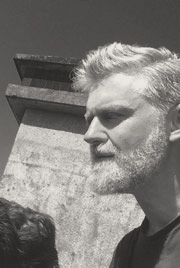
Dr Harry Willis Fleming is a historian (with an MRes and PhD in History) and a creative practitioner and consultant, concerned with the ways that architecture and place engage with memory and the imagination. His research explores topographical and spatial themes. His creative projects combine place-making, archive-making, design, and relational/social aesthetics. Key is the notion of place as muse, both for himself and for others.
Harry is an Honorary Research Fellow at Duncan of Jordanstone College of Art & Design at the University of Dundee.
Harry graduated in Theatre Design from Wimbledon School of Art (1994). He received a Master of Research in History (with distinction) from the University of Southampton (2011) and a doctorate from Middlesex University (2017). He was awarded a 2019/20 Postdoctoral Fellowship from the Paul Mellon Centre for Studies in British Art, to develop his doctoral thesis as a book.
Harry's academic research is situated within the disciplines of cultural history and the history of architecture, broadly conceived. His interests lie on the boundaries between art and non-artistic aesthetic practices. He is drawn to things that are sui generis, or not readily pinned down, or that have become culturally invisible through time. He engages with art and culture understood primarily as life, flow, and process rather than commodity production. The visual and experiential are central to his work, drawing on his original training as a theatre designer.
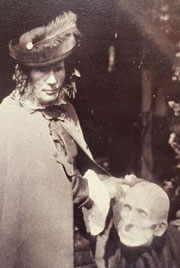
His recent scholarly research focus has been the nineteenth-century artist and tower-dweller Richard Cockle Lucas (1800-1883), for which he was awarded a Henry Moore Institute Research Fellowship (2012) and a funded doctoral Research Studentship at Middlesex University (2012-2016). He curated an archival display on Lucas at the Henry Moore Institute, Leeds, in 2017. He wrote 'Richard Cockle Lucas: "Truth is stranger than fiction even in the leaves of the Chestnut Tree"', Capturing Nature: 150 Years of Nature Printing, Matthew Zucker & Pia Östlund (eds), Princeton Architectural Press, 2023. In tandem with his research, Harry's creative projects are multidisciplinary and use sense of place, installation and immersive experience, collecting and curating, and the art of memory. His outputs in different media often take the form of archives and (re)constructions of places, with audiences constituted through the staging and hosting of social or commemorative circumstances.
He has taught on the 'Advanced Research' module of MA Spatial Cultures and MA Interiors (Architecture and Design) at Middlesex University.
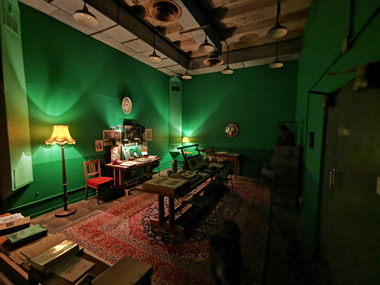
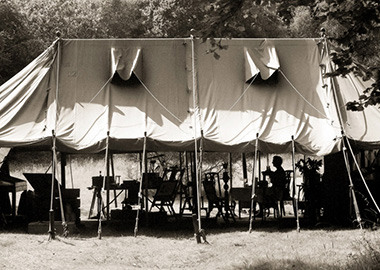
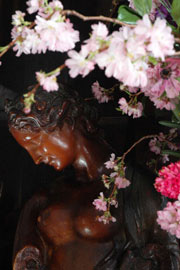
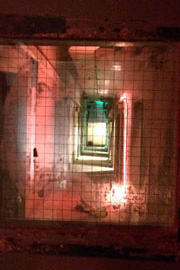
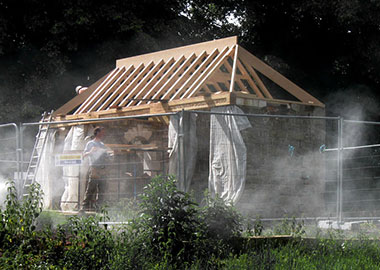
Harry wrote and presented Vapourtrain (2009) for BBC Radio 3, exploring how steam railway travel transformed notions of time, space, and place. He was a researcher and contributor to One Way To The Necropolis (2005) for BBC Radio 4, a feature programme on the Brookwood Necropolis Railway. The Lottery-funded restoration of the Stoneham War Shrine (2008-11) returned a derelict memorial to its original state using traditional craft skills, and positioned the monument as a key to unlocking the history of the local landscape through a series of public events. Harry devised and produced an experimental arts and broadcast project Station to Station (1997) at Aldwych Underground Station in London in collaboration with several artists, performers, broadcasters, and technologists. The Field Tent at North Stoneham (2008), with artist Jane Wildgoose, was a temporary museum and living-researching space at the site of demolished North Stoneham House. Harry co-designed and staged several incarnations of Gregory Whitehead's The Bone Trade in different media, including an immersive live event in London and an installation at Mass MOCA, Massachusetts. Harry has a strong commitment to the wider public engagement with history and heritage. He has given many public talks, put together community exhibitions and displays, and created several collaborative online research archives, such as the Swaythling Remount Depot. He was a steering group member for 'Tudor Revels' (2012), a Heritage Lottery-funded exploration of Tudor Southampton, and a project member for 'Spirit of place' (2007), a virtual memorial commissioned by Arts in Healthcare to commemorate the former All Saints Hospital in Eastbourne.
Harry had an early interest in digital media and was the graphic designer of David Owen's Balkan Odyssey CD-ROM (1997), an innovative multimedia archive recording the peace process in the former Yugoslavia.
As a design consultant, Harry's clients included London Underground, Atkins, Railtrack / Rail Safety & Standards Board, Royal Borough of Kensington & Chelsea, Virgin Group, Volkswagen Group, and the Wellcome Trust.
|